
Bracknell Forest had 97 certified heat pump installations in 2025, up from 52. The council's climate report also says Crowthorne's air quality zone will go.
Certified heat pump installations in Bracknell Forest nearly doubled last year. There were 97 in 2025, up from 52 in 2024 and just one in 2019.
The figures are in the council’s climate change annual report for 2025/26, which Cabinet noted on 3 November. Its metrics table also shows the borough’s carbon emissions down by a fifth since 2019, and says the air quality management area on Crowthorne High Street will be revoked.
Overview
- Heat pumps: 97 certified installations in 2025, against 52 in 2024.
- Home solar: 660 certified solar panel installations in 2025, up from 593.
- Borough emissions: 388.7 kilotonnes of CO2 equivalent in 2024, down from 489.5 in 2019.
- The council’s own emissions: 2,394 tonnes in 2025, down 14% on 2024.
- Crowthorne: the air quality management area is to be revoked because pollution has fallen.
- Recycling: 54% of waste was reused, recycled or composted, short of the 55% target.
Heat pumps and solar panels
The heat pump and solar figures come from the MCS Data Dashboard. MCS is a certification standard widely used for home and small-scale installations, so the count covers certified jobs of every heat pump type rather than every home.
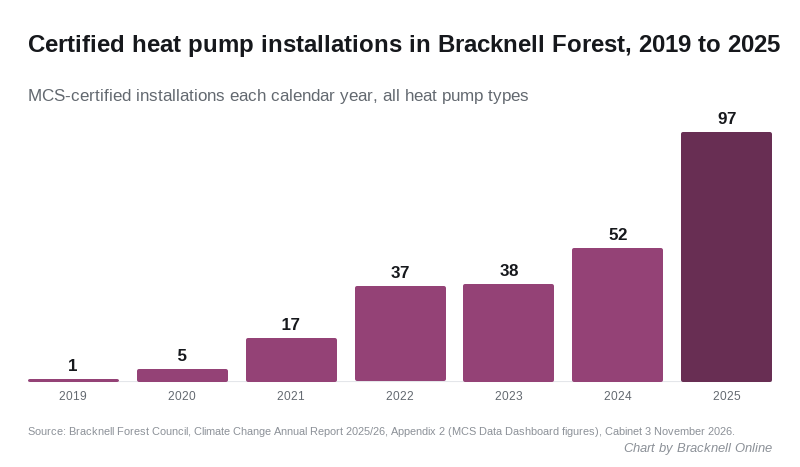
The count has risen every year since 2019. Across the seven years it adds up to 247 installations, according to the metrics table.
Solar panels are far more common. There were 660 certified solar panel installations in 2025, and 2,561 since 2019.
Some of those came through Solar Together, a group-buying scheme the council promotes. In 2025/26, 52 households fitted 609 panels through it and 50 added home batteries. The report puts residents’ total spend on those systems at £432,039.
Borough and council emissions
The borough’s emissions were 388.7 kilotonnes of CO2 equivalent in 2024, the latest year published. That is down from 489.5 kilotonnes in 2019, a fall of about 21%. The 2025 figure is due from the government in June 2027.
The council’s own direct emissions, from its fuel, gas and electricity, fell from 2,795 tonnes in 2024 to 2,394 tonnes in 2025. That is a cut of 14%.
Crowthorne’s air quality zone
The borough’s air quality management area is in Crowthorne, where pollution is monitored on the High Street. The report says work is now under way to revoke it, “reflecting lower pollution levels and local highway improvements, including changes along Crowthorne High Street”.
The latest annual average for nitrogen dioxide at the monitoring point was 17.5 micrograms per cubic metre. The legal objective is 40.
Waste, trees and the town centre heat network
- Waste: the borough collected 49,683 tonnes in 2025/26, 266 tonnes more than the year before. The share sent to landfill fell from 13% to 9%.
- Food waste: 5,455 tonnes went to anaerobic digestion, after collections were extended to every flat in the borough.
- Trees: the council’s parks and countryside team planted 6,382 trees, including a community orchard at Shepherd Meadows.
- Council buildings: 28 now have solar panels, supplying up to 4.5% of the council’s electricity.
- Heat network: a £100,000 bid for a feasibility study into a district heat network for Bracknell town centre was turned down. The report says other routes are being explored.
The council’s own summary of the report quotes Cllr Ryan Frost, cabinet member for climate change. “We still have work to do to further cut emissions and achieve net zero status,” he said, “but collectively we are making a difference to our local environment.”
The council’s aim is net zero for both its own operations and the borough “as close to 2030 as possible”. Its priorities for 2026/27 include on-street electric vehicle charging, the heat network and more energy work on council buildings.
What it means for you
- Check where your home loses heat for free. Thermal imaging cameras can be borrowed from Bracknell Forest libraries. Two are kept at Crowthorne and others at Great Hollands, Sandhurst and Whitegrove, and any library can request one. They were borrowed 76 times last year, the report says.
- Recycle household batteries from the kerb. Since 2 March 2026, batteries can go out in a clear plastic bag on top of the blue recycling bin on your bin collection day.
Have your say